
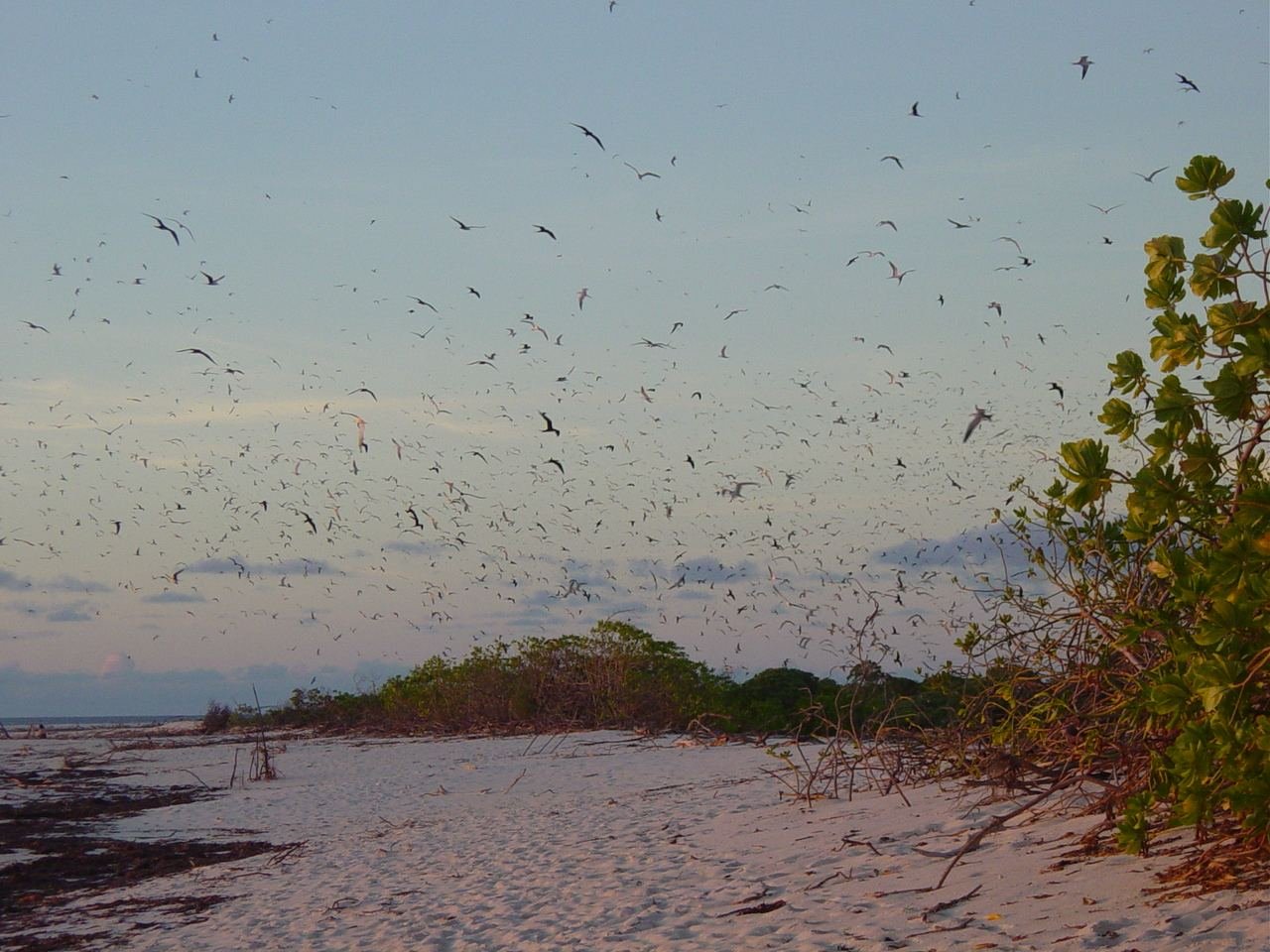
Photo: David Stanley from Nanaimo, Canada · CC BY 2.0 · Wikimedia Commons
Aldabra Atoll
UNESCO World Heritage with 100,000 giant tortoises — more than the Galápagos.
Aldabra is the world's second-largest coral atoll, lying 1,150 kilometres from Mahé — closer to Madagascar than to the rest of the Seychelles. Because it was never permanently settled, it preserves wildlife that has vanished elsewhere: around 100,000 Aldabra giant tortoises, more than the Galápagos, plus the Indian Ocean's last flightless bird. The atoll has been UNESCO World Heritage since 1982 and is strictly guarded by the Seychelles Islands Foundation. There are no hotels, no flights and no day trips — access comes solely via a handful of permitted expedition vessels, with a multi-day crossing and official authorisation. For most people Aldabra remains a place you know of rather than visit. Anyone planning it seriously counts in years, not weeks.
What makes it different
- Around 100,000 giant tortoises
- UNESCO World Heritage since 1982
- The Indian Ocean's last flightless bird
- Effectively untouched reefs
Suits
Nature travellers with time, budget and patience for a permit process.
Does not suit
Any normal holiday planning. There is no accommodation and no regular access.
Getting there
- Airport
- Seychelles International (SEZ), Mahé
- From Europe
- Direct flights from Frankfurt run seasonally. Otherwise the route goes via Doha, Dubai, Istanbul or Addis Ababa. Paris and Zurich also have regular one-stop connections.
- Duration
- Around 9.5 hrs non-stop, 13 to 16 hrs door to door when connecting.
- Entry
- No visa required, but a paid Travel Authorisation must be applied for online before departure. Without it airlines refuse boarding — the most common avoidable mistake on this route.
- Onward travel
- Praslin is 15 minutes by air or a good hour by ferry. La Digue is reached only by ferry from Praslin. The outer islands require a charter flight on fixed weekdays.
- Final leg
- Expedition vessel only, several days from Mahé
Routes and entry rules change. Check both with the authorities and your airline before booking — this is orientation, not a guarantee.
What the trip really costs
- Taxes and levies
- Since 2023 the state levies an environmental fee per night, scaled by the size of the property — small guesthouses pay considerably less than large resorts. VAT is usually already included in quoted prices. On top comes the Travel Authorisation fee, payable before departure.
- What the price covers
- Many properties offer breakfast only. Half board pays on the small islands where alternatives are scarce; on Mahé and Praslin eating out is markedly cheaper.
- What comes on top
- Food prices are the quiet cost driver: almost everything is imported. Restaurant prices sit closer to western Europe than to the rest of the Indian Ocean. A rental car on Mahé or Praslin costs little and saves taxi fares that quickly exceed the car.
- Tipping
- Tipping is not obligatory; five to ten per cent is customary and appreciated.
Rates and levies change, sometimes at the turn of the year. This describes the principle, not today's figure — ask your accommodation for the exact amount.
Common questions about Aldabra Atoll
When is the best time to visit Aldabra Atoll?
The best window is September to May. Those months average 7 rain days and air temperatures of 25 to 31 °C, with the sea at 26 to 29 °C and underwater visibility of 25 to 40 metres. The figures are for the climate zone Seychelles, outer islands. The cyclone season covers December to April — storms are rare but possible, and cancellation cover is worth more in those months than at other times.
Do I need a visa for the Seychelles?
No visa, but the Seychelles Travel Authorisation is mandatory — online before travel, one per person including children, base fee 10.90 euro. A return ticket, proof of accommodation and sufficient funds are required. Apply on the official site; a number of agents sell the same thing for several times the price.
Source: Seychelles Electronic Border System · checked on 2026-09-03
What comes on top of the room rate in the Seychelles?
On top of the room rate you pay: Tourism Environmental Sustainability Levy: per person per night 0 SCR (Small establishment, up to 24 rooms), 75 SCR (Medium establishment, 25 to 50 rooms), 100 SCR (Large establishment, island resort or yacht); Travel Authorisation: 10.90 EUR once per person. For two people and ten nights that comes to 2,000 SCR + 21.80 EUR. VAT of 15 % is usually already included in quoted rates.
Source: Tourism Seychelles · Seychelles Electronic Border System · checked on 2026-09-02
How long does it take to get to Aldabra Atoll?
The route from Europe runs via Seychelles International (SEZ), Mahé. Around 9.5 hrs non-stop, 13 to 16 hrs door to door when connecting. The final leg: Expedition vessel only, several days from Mahé.
How many nights are worth it?
There and back, that is about 20 hours of pure travel (flight each way; the transfer duration is not stated in any of our sources and is not counted here); connections and waiting are not counted, they depend on the routing. Over five nights that puts 14 % of the trip on the way there and back, over ten 8 % and over fourteen 6 %. What follows from that is the traveller's call.
What currency and what sockets are used in the Seychelles?
Seychelles rupee (SCR). Hotels, dive centres and car hire may bill in foreign currency; markets and buses take rupees. 240 V, plug type G (British). The same adapter as for the Maldives.
What trips are there around Aldabra Atoll?
We list one thing to do here: Aldabra by expedition ship — all year.
The answers above are computed from our data, not written by hand. Change a figure in the data and the sentence changes with it. Official matters — entry rules, tax rates — should still be confirmed at the source before you book.
In the same country
 Seychelles
Own illustration
Alphonse Atoll
One of the world's premier saltwater fly-fishing grounds — bonefish on endless sand flats.
 Seychelles
Own illustration
Astove Atoll
The Astove Wall drops almost vertically to over a thousand metres.
 Seychelles
Photo: original: Phil Guest · CC BY-SA 2.0 · Wikimedia Commons
Bird Island
Up to 1.5 million sooty terns breed here between May and October.