
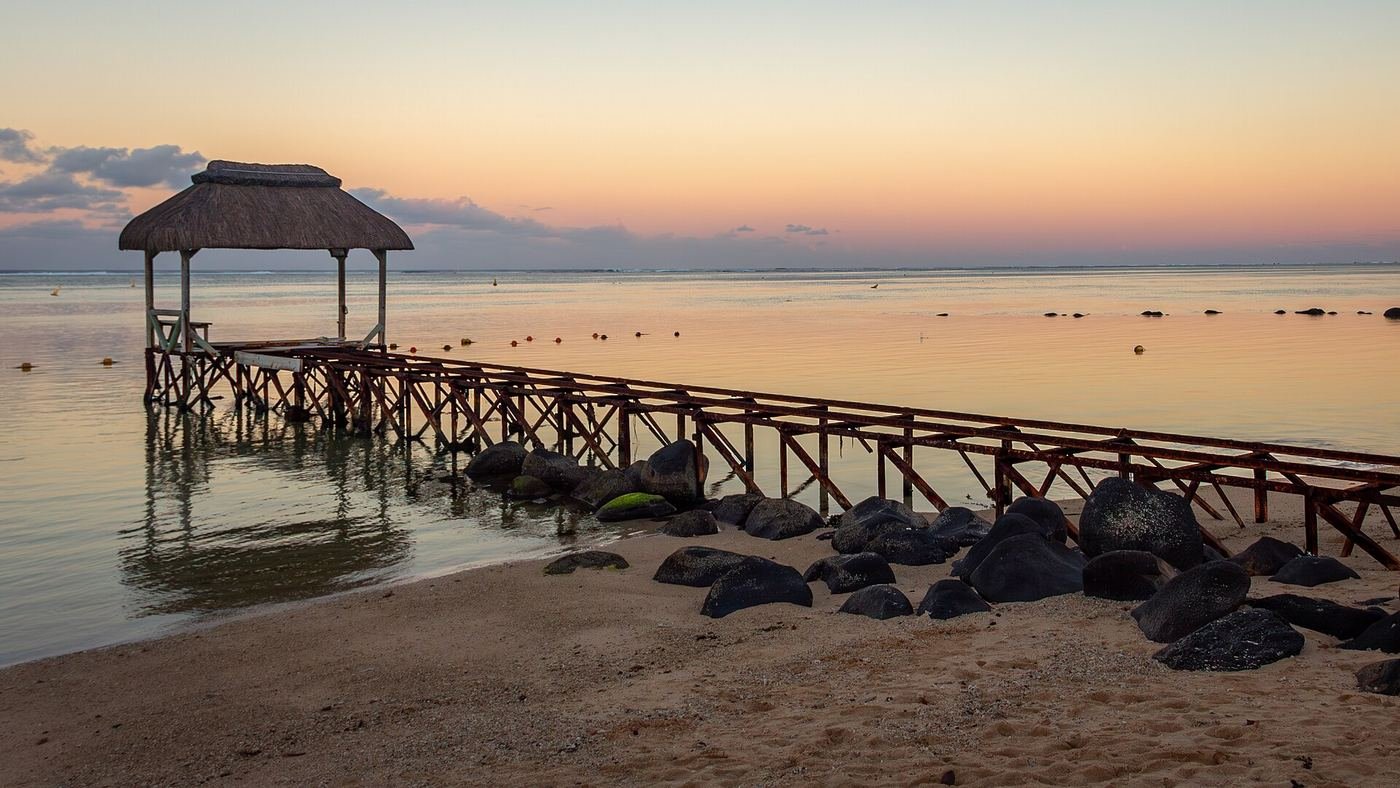
Photo: dronepicr · CC BY 2.0 · Wikimedia Commons
Le Morne (south-west)
A UNESCO World Heritage mountain, a world-class kite spot and the "underwater waterfall" in one place.
Le Morne Brabant is a 556-metre basalt monolith at the south-western tip and a UNESCO World Heritage site since 2008 — not for its looks but for its history: escaped slaves hid on its barely accessible summit. The climb takes around three hours and the upper section is guide-only. Below lies the lagoon where two wind systems meet, making One Eye one of the world's best-known kite spots, with a wave right on the reef for the experienced and flat water inside for everyone else. Offshore, a sand drift along the reef edge creates, from the air, the illusion of an underwater waterfall. The hotels are few and upmarket; the setting is the most dramatic on the island.
What makes it different
- The climb up the UNESCO World Heritage mountain
- One Eye — a world-class kite spot
- The "underwater waterfall" seen from the air
- The island's most dramatic setting
Suits
Kitesurfers, hikers, and couples who rate landscape above beach length.
Does not suit
Anyone wanting still air. The wind that makes the kite spot also crosses your sunlounger.
Places to stay
These properties are located at this destination. The price level is our own rough classification — not a quote from the property, not a price, and not a booking service. We have no business relationship with them.
-
Riu Le Morne€
-
LUX* Le Morne€€
-
Lux Le Morne Villas€€
-
Paradis Beachcomber€€€
-
Dinarobin Beachcomber€€€
-
JW Marriott Mauritius€€€
Getting there
- Airport
- Sir Seewoosagur Ramgoolam (MRU), in the island's south-east
- From Europe
- Paris has year-round direct flights, Frankfurt seasonal ones. One-stop routes go via Dubai, Doha or Istanbul. Mauritius is the most easily reached of the three.
- Duration
- Around 11 hrs non-stop from Paris, 14 to 16 hrs door to door when connecting.
- Entry
- No visa for EU nationals up to 90 days. A return ticket and proof of accommodation are required. Your passport must be valid for the whole stay.
- Onward travel
- Unlike the Maldives you drive here: the airport is in the south-east, most hotels on the north and west coasts. Allow 45 to 90 minutes by car. A rental car pays off because the island has plenty to see inland.
- Final leg
- 60 min by car from the airport
Routes and entry rules change. Check both with the authorities and your airline before booking — this is orientation, not a guarantee.
What the trip really costs
- Taxes and levies
- No separate tourism tax. VAT is included in quoted prices; many hotels add a service charge. Of the three destinations Mauritius holds the fewest surprises on the final bill.
- What the price covers
- Half or full board is common but pays off less than in the Maldives — outside the hotels there is a real restaurant scene, from street food to fine dining.
- What comes on top
- Price levels outside the resorts are markedly lower than at the other two destinations. A rental car is cheap and is what makes the island accessible; staying put means paying a multiple for excursions.
- Tipping
- Around ten per cent in restaurants is customary; in hotels at your discretion.
Rates and levies change, sometimes at the turn of the year. This describes the principle, not today's figure — ask your accommodation for the exact amount.
Common questions about Le Morne (south-west)
When is the best time to visit Le Morne (south-west)?
The best window is May to June and September to December. Those months average 6 rain days and air temperatures of 20 to 29 °C, with the sea at 24 to 27 °C and underwater visibility of 20 to 30 metres. The figures are for the climate zone Mauritius, west and north coast. The cyclone season covers November to April — storms are rare but possible, and cancellation cover is worth more in those months than at other times.
Do I need a visa for Mauritius?
No visa for EU nationals; tourist stays of up to 90 days are free. The All-in-One Travel Form is mandatory — online, within three days before arrival; it produces a QR code that is scanned at the airport. It replaces the old paper arrival card and is not a visa. A return ticket and proof of accommodation are also required.
Source: Safe Mauritius — All-in-One Travel Form · checked on 2026-09-03
What comes on top of the room rate in Mauritius?
On top of the room rate you pay: Tourist fee: 3 EUR per person per night. For two people and ten nights that comes to 60 EUR. VAT of 15 % is usually already included in quoted rates.
Source: Mauritius Revenue Authority · checked on 2026-09-02
How long does it take to get to Le Morne (south-west)?
The route from Europe runs via Sir Seewoosagur Ramgoolam (MRU), in the island's south-east. Around 11 hrs non-stop from Paris, 14 to 16 hrs door to door when connecting. The final leg: 60 min by car from the airport.
How many nights are worth it?
There and back, that is about 24 hours of pure travel (flight and transfer each way); connections and waiting are not counted, they depend on the routing. Over five nights that puts 17 % of the trip on the way there and back, over ten 9 % and over fourteen 7 %. What follows from that is the traveller's call.
What currency and what sockets are used in Mauritius?
Mauritian rupee (MUR). Larger amounts are taken in euros too, at a worse rate. 230 V, plug types C and G — European round pins AND British flat pins. Rooms usually have both.
What trips are there around Le Morne (south-west)?
We list 3 things to do here: Humpbacks off the west coast — July to October; Kitesurfing at Le Morne — May to October; Dolphins off Tamarin — all year.
The answers above are computed from our data, not written by hand. Change a figure in the data and the sentence changes with it. Official matters — entry rules, tax rates — should still be confirmed at the source before you book.
In the same country
 Mauritius
Photo: jokin.lacalle · CC BY 2.0 · Wikimedia Commons
Bel Ombre (south)
Beach hotels with an attached nature reserve — hiking and swimming on the same day.
 Mauritius
Photo: Arne Müseler · CC BY-SA 3.0 de · Wikimedia Commons
Belle Mare (east)
The island's widest, whitest beach — over ten kilometres in one stretch.
 Mauritius
Photo: GrandEscogriffe · CC BY-SA 4.0 · Wikimedia Commons
Blue Bay (south-east)
A protected marine park with intact coral — and just 15 minutes from the airport.