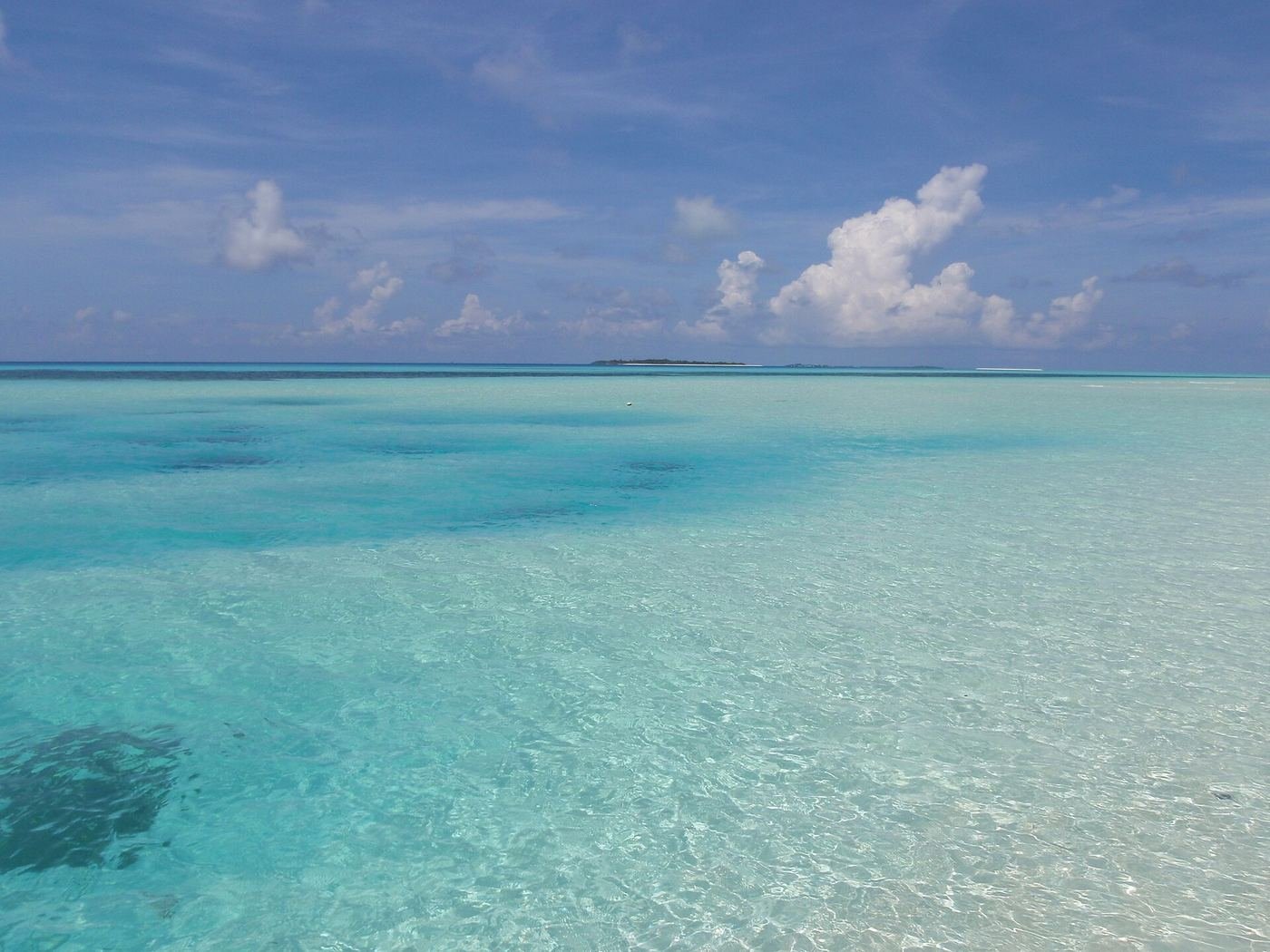
Photo: wardyboy400 · CC BY 2.0 · Wikimedia Commons
Lhaviyani Atoll
The Skipjack II wreck and turtle reefs you can reach without a boat.
Lhaviyani is a compact atoll with unusual substance for its price bracket. The Skipjack II wreck sits at comfortably divable depth and is overgrown with soft coral; Kuredu Caves and Fushivaru Thila rank among the country's most dependable sites. What sets the atoll apart is the density of green sea turtles — on several house reefs you'll see them while snorkelling, never having boarded a boat. Resort structure is mixed: a few large, strongly dive-oriented islands with good value sit alongside a handful of luxury addresses. That is useful for families, because dive base, shallow lagoon and childcare often share one island, and the budget doesn't disappear entirely into the villa.
What makes it different
- Skipjack II wreck
- Green turtles on the house reef
- Kuredu Caves and Fushivaru Thila
- Good value for a seaplane atoll
Suits
Diving families and couples who put underwater substance above villa luxury.
Does not suit
Anyone after very small, exclusive islands — some resorts here are large.
Places to stay
These properties are located at this destination. The price level is our own rough classification — not a quote from the property, not a price, and not a booking service. We have no business relationship with them.
-
Kuredu Island Resort€
-
Innahura Maldives Resort€
-
Komandoo Island Resort€€
-
Cocoon Maldives€€
-
Atmosphere Kanifushi€€€
-
Le Méridien Maldives€€€
-
Hurawalhi Island Resort€€€
-
Kanuhura Maldives€€€€
Getting there
- Airport
- Velana International (MLE), Malé
- From Europe
- Direct flights from Frankfurt and Munich run in the winter half-year. Year-round the usual route is via the Gulf or Turkish hubs — Istanbul, Doha, Dubai, Abu Dhabi. Connecting is usually cheaper and offers more departure days.
- Duration
- Around 10 hrs of flying non-stop, 14 to 17 hrs door to door when connecting.
- Entry
- A 30-day visa is issued free on arrival. Your passport must be valid for at least one month beyond your stay. In addition, an online Traveller Declaration must be filed within 96 hours before arrival.
- Onward travel
- The final leg decides your day: seaplanes fly in daylight only. Landing in Malé in the evening means a night on Hulhumalé and onward travel next morning. Domestic flights and speedboats are not affected.
- Final leg
- Seaplane, 40 min from Malé
Routes and entry rules change. Check both with the authorities and your airline before booking — this is orientation, not a guarantee.
What the trip really costs
- Taxes and levies
- Two charges are added to every night and rarely appear in the quoted price: the Green Tax per person per night — double in resorts compared with guesthouses on local islands — and the tourism tax TGST on the bill. Most properties add a ten per cent service charge on top. Between brochure price and final bill, twenty per cent or more is common.
- What the price covers
- Depending on the board level the resort price covers room and meals. What is almost never included: the transfer to the island, drinks outside meals, and excursions.
- What comes on top
- The transfer is the largest single item after the flight. A return seaplane usually costs a three-figure sum per person; a domestic flight with boat connection is often less. Ask for the price before booking — it is rarely quoted and can reverse a cheap-looking offer.
- Tipping
- Tipping is customary despite the service charge, but not expected. If you tip, tip directly.
Rates and levies change, sometimes at the turn of the year. This describes the principle, not today's figure — ask your accommodation for the exact amount.
Common questions about Lhaviyani Atoll
When is the best time to visit Lhaviyani Atoll?
The best window is December to March. Those months average 7 rain days and air temperatures of 25 to 31 °C, with the sea at 28 to 29 °C and underwater visibility of 25 to 30 metres. The figures are for the climate zone Maldives, north. The weakest stretch is May to September.
Do I need a visa for the Maldives?
No visa needed: 30 days are granted free on arrival. A return ticket, booked accommodation and sufficient funds are required. The free online IMUGA declaration is mandatory — one per person, infants included, within 96 hours before arrival and again before departure. Sources disagree on passport validity: immigration asks for one month beyond departure, many airlines and operators insist on six. Six months of validity satisfies both.
Source: Maldives Immigration — Tourist Visa on Arrival · IMUGA Traveller Declaration · checked on 2026-09-03
What comes on top of the room rate in the Maldives?
On top of the room rate you pay: Green Tax: per person per night 12 USD (Resort, hotel, safari vessel), 6 USD (Guesthouse on an inhabited island); Service charge: 10 % on the bill for accommodation and services; TGST — tourism tax: 17 % on the bill including the service charge. For two people and ten nights the fixed amounts alone come to 240 USD; the percentages are added to the bill on top of that.
Source: MIRA — Maldives Inland Revenue Authority · MIRA — Tourism Goods and Services Tax · checked on 2026-09-02
How long does it take to get to Lhaviyani Atoll?
The route from Europe runs via Velana International (MLE), Malé. Around 10 hrs of flying non-stop, 14 to 17 hrs door to door when connecting. The final leg: Seaplane, 40 min from Malé. Seaplanes fly by sight and therefore only in daylight. Land in Malé in the evening and you stay the night, flying on the next morning — a day of your holiday and a hotel night that no quoted price includes.
How many nights are worth it?
There and back, that is about 24.3 hours of pure travel (flight and transfer each way); connections and waiting are not counted, they depend on the routing. Over five nights that puts 17 % of the trip on the way there and back, over ten 9 % and over fourteen 7 %. What follows from that is the traveller's call.
What currency and what sockets are used in the Maldives?
Rufiyaa (MVR), but resorts and guesthouses bill in US dollars. Euros are taken almost everywhere, at a worse rate. 230 V, plug types D and G (British, three flat pins). Bring an adapter; many resorts have them, not all.
What trips are there around Lhaviyani Atoll?
We list 2 things to do here: Picnic on a sandbank — all year; House reef, no boat needed — all year.
The answers above are computed from our data, not written by hand. Change a figure in the data and the sentence changes with it. Official matters — entry rules, tax rates — should still be confirmed at the source before you book.
In the same country
 Maldives
Photo: Mark Hodson Photos · CC BY 2.0 · Wikimedia Commons
Addu Atoll
The only Maldivian islands linked by causeway — you can genuinely cycle here.
 Maldives
Photo: Civvi · CC BY-SA 3.0 · Wikimedia Commons
Ari Atoll
A year-round whale shark population in the south — nowhere else in the Maldives is as reliable.
 Maldives
Photo: Matheenfaiz · CC BY-SA 4.0 · Wikimedia Commons
Baa Atoll
UNESCO Biosphere Reserve with Hanifaru Bay — the world's most reliable manta gathering.